KTX is a toroidal magnetic confinement device similar to a conventional Tokamak. The schematic of KTX is shown infigure1. It has several parts: the vacuum vessel, the conducting shell,the OH coils,the EQ coils,the TF coils,the active feedback coils and the supporting structures.
The overall height of KTX machine is 4.8m and its outer diameter is up to 7.8m. Two 180o sections, composing the vacuum vessel in gray as shown in figure1, are jointed by flanges. A modular conducting shell is attached tightly on the surface of the vacuum vessel. Located just outside the shell, there are 96 saddle coils served for active feedback control. The set of coils consist of 24×4 coils along the toroidal and the poloidal direction respectively. Each saddle coil has a toroidal extension of 15o and a poloidal extension of 90o. The active feedback system also includes 24×4sensors distributed in the very narrow space between the vessel and the shell. Each sensor probe overlaps the corresponding active feedback coil. The 24 TF coils in redare placed around the major circumference. The vacuum vessel, the shell and the TF coils are assembled on a circular plate, and the plate is supported by 8 supporting pillars. There are 12 EQ coils in blue color distributed up and down symmetrically. The outmost part are OH coils in yellow, which are distributed around the torus. The EQ coils and OH coils are supported on eight rectangular legs, and those structures are assembled on a solid ground to take the electrodynamic force in the coils.
As shown in figure 2, the TF coils, the vacuum vessel and the conducting shell are mounted on the movable platform. The supporting pillars are fixed on two pedestals, the bottoms of which are assembled on two linear guide rails. Thus two parts of the vacuum vessel, the shell and the 24 TF coils can be moved in opposite directions to provide one man’saccess to the inside of the machine. This structure, called “double-C”,makes the machine be opened easily without dissembling the poloidal field windings. This advantage is especially important for machine maintenance in a campus laboratory. Since one of the research issues is boundary physics of RFP, the aperture will allow internal manual operation for wall conditioning and replacement of parts.
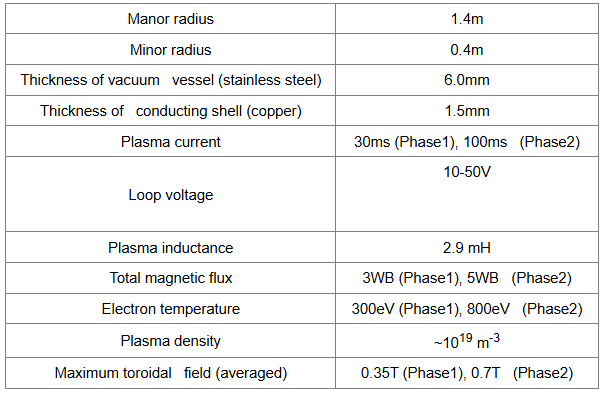
Table 1.Main parameters of KTX machine
 联系电话:
联系电话: 联系邮箱:
联系邮箱: 联系地址:
联系地址: